

TL;DR: Improperly disposing of construction and demolition waste in NSW can result in significant fines. Aussie Industries' EPL-licensed recycling centres in Greenacre and Strathfield South provide compliant, documented disposal for builders of all sizes.
Construction waste disposal comes down to one simple question for Sydney builders: did the waste end up somewhere that can lawfully accept it? Under NSW law, builders are legally required to send construction and demolition waste to a site permitted to receive it. Disposing of materials at an Environment Protection Licence (EPL) recycling centre provides the documented compliance records needed to satisfy regulatory requirements.
Aussie Industries has managed waste across Greater Sydney since 1987. With facilities in Greenacre and Strathfield South, our two centres provide a quick, central run for builders working across Canterbury-Bankstown, Strathfield, the Inner West, and South-West Sydney.
What is Construction and Demolition Waste?
Construction and demolition (C&D) waste is the material a build, renovation, fit-out or demolition leaves behind, and the NSW EPA's guidance for builders covers all of it, including the narrower legal category of "building and demolition waste"2.
The EPA's Waste Classification Guidelines define building and demolition waste as unsegregated material from demolishing, erecting, constructing, refurbishing or altering buildings, or from building and repairing infrastructure such as roads, tunnels and utilities. It includes bricks, concrete, paper, plastics, glass, metal and timber, including chemically treated timber4.
Two things sit outside that definition: material containing asbestos or liquid waste, plus excavated soil4. That's why soil and asbestos carry their own bins and pricing later in this guide.
The same guidelines pre-classify building and demolition waste as general solid waste (non-putrescible), or GSW, meaning waste that doesn't rot or break down the way food and garden organics do4. Getting that classification right is the first step in construction waste disposal Sydney regulators will accept.
NSW Legal Requirements for Builders
Every decision Sydney builders make about construction waste disposal is measured against section 143 of the Protection of the Environment Operations Act 1997 (POEO Act). Section 143 requires waste to be transported to a place that can lawfully accept it, and the owner of the waste and the transporter are each guilty of an offence when it isn't2.
For builders, the detail that matters is who counts as the owner. Under section 143(4), the owner includes whoever owned the waste immediately before it was transported, so the liability stays with your business after a subcontractor's truck leaves the gate3.
The Act gives owners one defence. If you didn't transport the waste yourself, you need to show the offence happened for reasons outside your control and that you took reasonable precautions and exercised due diligence to prevent it3.
What due diligence looks like on site:
The EPA's owner's guide sets out the checks that build that defence:3
- Check each waste contractor's ABN and look up their EPL on the EPA Public Register, then keep the search results.
- Make lawful transport and disposal a written contract condition, and make sure subcontract arrangements match it.
- Confirm where the waste is going and that the receiving site is permitted to take that waste type.
- Track and record waste as it leaves site so you can check disposal dockets against your dispatch records.
- Ask for evidence of lawful disposal before paying a contractor or subcontractor.
- Report suspected unlawful transport or disposal to the EPA as soon as possible.
Running those checks on every job turns construction waste disposal Sydney councils or the EPA could question into a documented process1.
Giving another person false or misleading information about waste is a separate offence under section 144AA3. Asbestos adds removal and tracking rules on top of these duties, covered under what Aussie accepts below.
The Cost of Getting It Wrong: Fines and Liability
Unlawful construction waste disposal in Sydney carries severe financial and legal risks, with statutory maximum penalties doubling following major legislative reforms. Under the Environment Protection Legislation Amendment (Stronger Regulation and Penalties) Act 2024, maximum penalty ceilings for common builder exposure offences under the Protection of the Environment Operations (POEO) Act include:
Offence | Individual | Corporation |
Section 143: unlawful transport or deposit of waste (non-asbestos) | $500,000 | $2,000,000 |
Section 143: unlawful transport or deposit of asbestos waste | $1,000,000 | $4,000,000 |
Tier 1: harm to the environment from waste disposal (negligent) | $1,000,000 | $4,000,000 |
Tier 1: harm to the environment from waste disposal (wilful) | $2,000,000 | $10,000,000 |
Where a non-asbestos waste offence continues, the court can add a further $120,000 a day for an individual and $240,000 a day for a corporation5.
The penalty isn't the only bill. The waste owner and the transporter can both be ordered to clean up and pay to have the waste taken to a lawful place2.
What is an EPA Environmental Protection Licence?
An environment protection licence (EPL, the legal term under the POEO Act) is a legally enforceable document issued by the NSW EPA that lists the activities a business can carry out and the conditions it has to meet, and breaching it is an offence. Waste resource recovery, waste processing and waste storage all need an EPL once they pass set thresholds, and the licence has to be in place before the facility starts operating6.
What a licensed C&D facility has to do
Since 15 May 2019, construction and demolition waste facilities have had to meet the EPA's Standards for Managing Construction Waste in NSW, which require7:
- a two-stage inspection process that keeps asbestos and other unpermitted waste out
- sorting and waste storage procedures
- trained staff for every task the Standards cover
Non-compliance with the Standards is a breach of section 64 of the POEO Act7. Licensed scheduled waste facilities also report every tonne they receive to the EPA through a Waste Contribution Monthly Report8.
Why Aussie's EPL sets it apart from unlicensed operators
Both the owner of the waste and the transporter are legally responsible for proving the waste went to a lawful place2. A licensed facility makes that proof simple, because its licence document shows the premises address, the operator and the waste types the site is permitted to accept3. An unlicensed yard has no equivalent document to hand you, which leaves your defence resting on the operator's word.
That's why the licence status of the receiving site is the first thing to check in any construction waste disposal Sydney contractors arrange. Choosing an EPA-licensed waste facility Sydney that builders can verify takes that risk off the table. Aussie Recycling operates both centres under its EPLs, and the Greenacre licence is EPL 213899.
What Does Aussie Industries Accept?
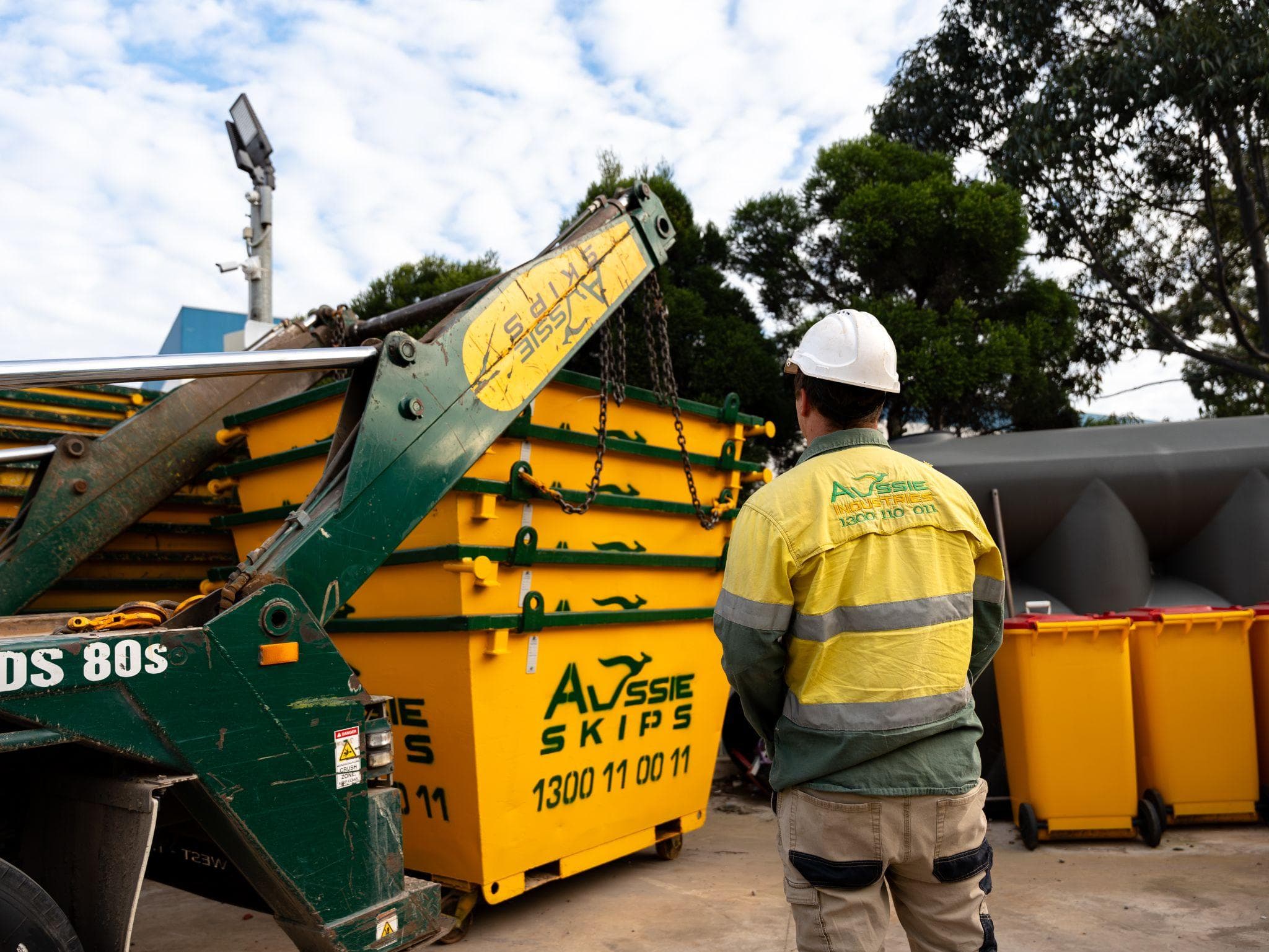
For demolition waste removal, Sydney builders can load Aussie's builder's bins with the everyday C&D streams, from rubble and timber through to plasterboard and mixed site debris.
Waste Stream | What's Accepted |
Demolition waste | Concrete, bricks, tiles and rubble |
Heavy materials | Soil, sand and asphalt (in permitted bins) |
Timber | Off-cuts, packaging and treated timber |
General site debris | Plasterboard, gypsum and mixed construction waste |
At the recycling centres, Aussie Recycling also takes construction and industrial waste, scrap metal, e-waste, green waste, mattresses and office waste.
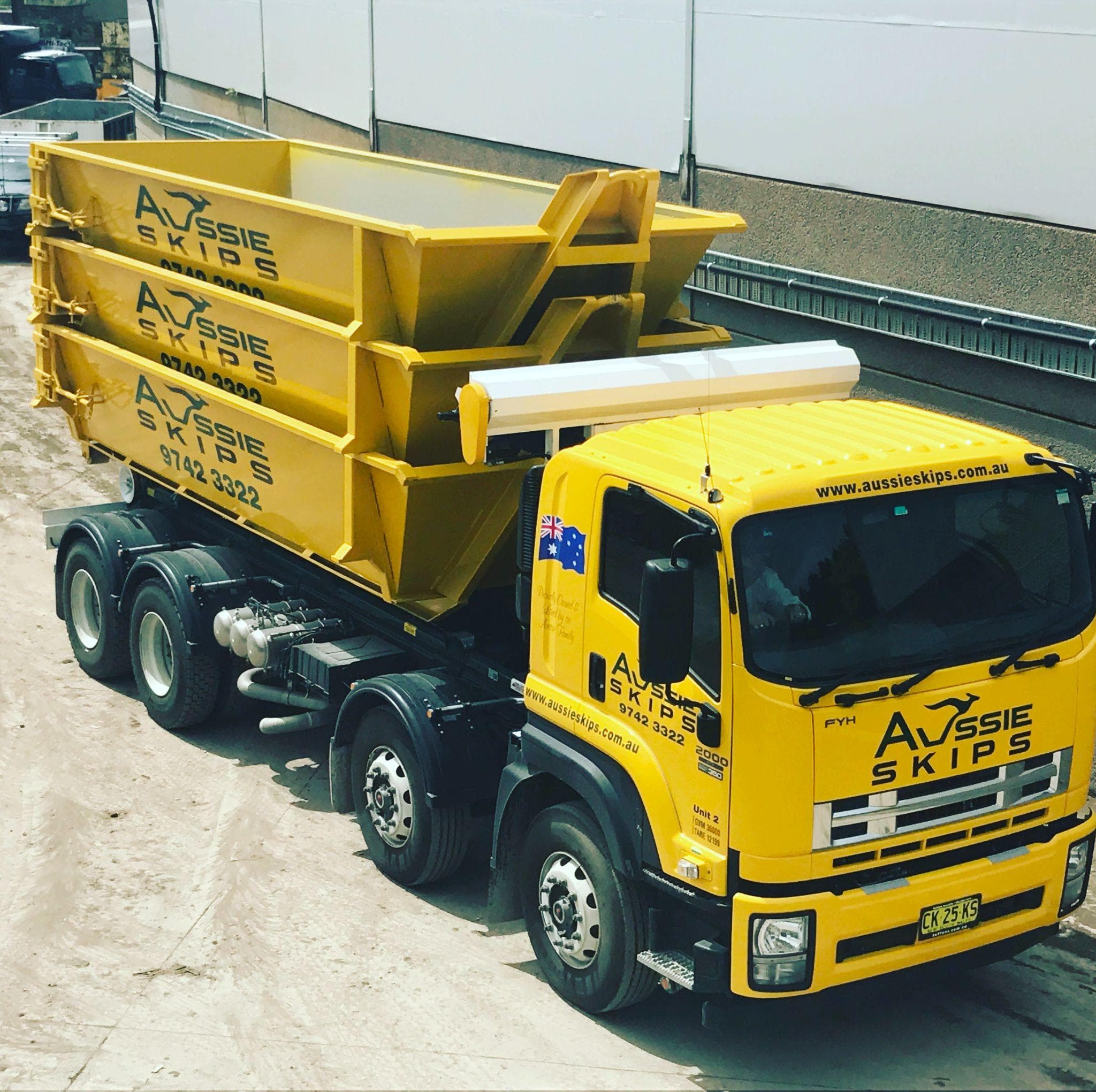
Bin sizing for builder skip bin hire Sydney jobs follows the scale of the work. A 2m³ to 4m³ bin suits bathroom renos and fit-outs, 6m³ suits full home renovations and large extensions, while 8m³ and up handles new builds and large demolitions. The builder's skip bin hire page matches bins to job types in more detail.
What isn't accepted, and the compliant alternative
Item | Status | Compliant alternative |
Asbestos and fibro | Not accepted in standard builder's bins or at the recycling centres | Dedicated bonded asbestos bins from Aussie Skips: from $2,000 (2 Marrel), $4,800 (6 Marrel) and $6,000 (10 Marrel) |
Chemicals, liquids and paint | Not accepted | Call the team for guidance. Liquid waste is classified separately from GSW under the EPA's guidelines4 |
Gas bottles | Not accepted | Call the team for guidance |
Food waste from site sheds | Not accepted at the recycling centres | Aussie's commercial collection bins take food waste |
If asbestos turns up mid-demolition, two regulators get involved. SafeWork NSW requires a licensed asbestos removalist for any amount of friable asbestos and for more than 10m² of non-friable (bonded) asbestos10. Once it's loaded, any load of 100kg or more, or 10m² or more of asbestos sheeting, has to be tracked and reported to the EPA through the Integrated Waste Tracking Solution (IWTS) by the transporter and the receiving facility11.
How Much Does C&D Disposal Cost?
Standard Aussie Skips bins start at $450 for a 2 Marrel of concrete and bricks and run to $2,660 for a 30 Hook Lift for general waste. Aussie publishes these prices, so you can budget the construction waste disposal Sydney jobs need before you book. Prices include GST and up to 7 days' hire on online bookings.
Bin | Max Weight | General Waste | Concrete and Bricks | Soil, Dirt and Clay |
2 Marrel (2.59m³) | 1 tonne | $510 | $450 | $830 |
3 Marrel (3.46m³) | 2 tonnes | $600 | $580 | $950 |
4 Marrel (4.61m³) | 3 tonnes | $710 | $660 | Call us |
6 Marrel (6.91m³) | 3 tonnes | $920 | $810 | $1,350 |
10 Marrel (10.56m³) | 5 tonnes | $1,450 | Call us | Call us |
14 Marrel (13.91m³) | 6 tonnes | $1,810 | Call us | Call us |
13 Hook Lift | 4 tonnes | $1,490 | $1,270 | $1,900 |
Larger 18, 25 and 30 Hook Lift bins (4 tonnes max) are $1,960, $2,330 and $2,660 for general waste. All prices are as published for October 2026.
On top of the bin price, budget for:
- a 4.8% fuel surcharge on the order total
- $330 (incl. GST) for every tonne over the bin's maximum weight
- $165 + GST per hour of waiting time after the first 20 minutes on site
- engineered stone, charged at $350 + GST per tonne
- $30 to $50 more for general waste and concrete bins in outer suburbs such as Dural, Kurrajong and Thirlmere, or $150 more for soil bins
Separating heavy materials is the simplest saving: a 6 Marrel of concrete and bricks costs $110 less than the same bin filled with general waste.
The biggest fixed cost behind any Sydney disposal price is the NSW waste levy, set at $180.20 per tonne in the Metropolitan Levy Area for 2026-27. That area takes in the Sydney metropolitan area12. The levy applies to EPA-licensed waste processing, resource recovery and waste storage facilities in the regulated area and is charged per tonne, so the price of construction waste disposal Sydney contractors pay tracks weight as much as volume8.
To price a specific job, book a bin online using your site postcode, waste type and dates.
Volume Pricing and Trade Accounts
Aussie doesn't list trade or volume rates on its website, so ongoing work starts with a conversation with the team. Every account is assigned a dedicated account manager to look after your needs as they come up.
Managing ongoing construction waste disposal across multiple Sydney job sites is far simpler with a single commercial account. On-account clients receive complimentary access to the MyAussie portal, built specifically for builders, trades, and site managers. Accessible via desktop, tablet, or mobile, the portal allows you to:
- Book bins, changeovers and pick-ups
- Keep every site, order and invoice under one login
- Track order status and deliveries in real time
For sites that need regular servicing rather than one-off commercial skip bin hire, Aussie runs ongoing front-lift and rear-lift collection programs. Bins stay on site between collections, with frequencies ranging from low-volume pick-ups to weekly or daily removal, and front lift bins come in 1.5m³, 3m³ and 4.5m³ sizes.
How to set up an ongoing account
- Call 1300 11 00 11 and talk the team through your sites, waste streams and expected volumes.
- Once you're on account, request MyAussie access through the portal enquiry form, which asks for your name, email, mobile and company name.
- Agree with your account manager what disposal paperwork comes back with each load, so it slots straight into the due diligence records your contracts require.
Our Strathfield South and Greenacre Facilities
Aussie Recycling operates purpose-built, 100% undercover facilities in Strathfield South and Greenacre, ensuring bad weather won't hold up your drop-off.
- Greenacre: Located at 13 Bellfrog Street, Greenacre.
- Strathfield South: Centrally positioned for quick access from the Inner West and Sydney's south-east.
Both locations feature dual weighbridges to get trucks weighed, tipped and back on the road quickly, keeping your crews on the job rather than waiting at the gate.
Trading Hours:
- Monday to Friday: 7:00 am – 5:00 pm
- Saturday: 7:00 am – 1:00 pm
- Sunday: Closed
Aussie Industries is fully certified to ISO 9001 (Quality), ISO 14001 (Environment), and ISO 45001 (Safety), and is an active industry partner of the Waste Management and Resource Recovery Association of Australia (WMRR) and the Waste Contractors and Recyclers Association (WCRA).
Frequently Asked Questions
Who is legally responsible for construction waste in NSW?
For construction waste disposal Sydney builders arrange, the owner of the waste and the transporter are each liable under section 143 of the POEO Act if the waste goes to a place that can't lawfully accept it2. The owner includes whoever owned the waste immediately before it was transported3.
What's the maximum fine for unlawfully disposing of construction waste in NSW?
Up to $2,000,000 for a corporation and $500,000 for an individual under section 143 for non-asbestos waste, rising to $4,000,000 and $1,000,000 where asbestos is involved1.
Is the C&D waste Sydney builders produce classified as general solid waste?
Yes. The EPA pre-classifies building and demolition waste as general solid waste (non-putrescible), although asbestos-containing material and excavated soil fall outside that category4.
How do I check whether a waste facility holds an EPA licence?
Search the EPA Public Register at epa.nsw.gov.au/prpoeoapp and open the record to view the licence document3.
Can I put asbestos or fibro in a builder's skip bin?
No. Aussie's standard builder's bins and recycling centres don't take asbestos or fibro, but Aussie Skips offers separate bonded asbestos bins. Removing more than 10m² of bonded asbestos needs a licensed removalist10.
What is the NSW waste levy for 2026-27?
$180.20 per tonne in the Metropolitan Levy Area, which includes Sydney, and $103.80 per tonne in the Regional Levy Area12.
Do I need a council permit for a skip bin on a construction site?
Not if the bin sits on private property, such as a driveway or inside the site boundary. A bin on a footpath, nature strip or road needs a permit from the local council. The hirer arranges the permit, and Aussie provides the bin dimensions for the application.
How quickly can Aussie deliver a bin to site?
Book before 10am Monday to Friday, or before 9am on Saturday, for same-day delivery.
Does Aussie Industries offer trade accounts?
Yes. For the ongoing construction waste disposal Sydney builders run across multiple sites, Aussie gives on-account clients a dedicated account manager and free access to the MyAussie portal.
Where can I drop off demolition waste in Sydney?
At Aussie Recycling's EPL-licensed centres in Greenacre and Strathfield South, which accept building and demolition waste six days a week.
Set Up Compliant Disposal for Your Next Project
Compliant construction waste disposal starts before the first bin lands on site: secure the right destination, set clear contract terms, and ensure full traceability for every load. Call the Aussie team on 1300 11 00 11 to arrange skip bins, open a trade account or set up drop-offs for your next Sydney job.
Sources Cited
- NSW Environment Protection Authority, Environment Protection Legislation Amendment (Stronger Regulation and Penalties) Act 2024 (guidance on new maximum penalties). https://www.epa.nsw.gov.au/Working-together/For-local-government/Stronger-regulation-and-penalties
- NSW Environment Protection Authority, Construction and demolition waste. https://www.epa.nsw.gov.au/Your-environment/Waste/industrial-waste/construction-demolition
- NSW Environment Protection Authority, Construction and demolition waste: an owner's guide to lawful disposal (2019). https://epa.nsw.gov.au/sites/default/files/19p1761-construction-and-demolition-waste-disposal-fact-sheet.pdf
- NSW Environment Protection Authority, Waste Classification Guidelines Part 1: Classifying waste (November 2014). https://www.epa.nsw.gov.au/sites/default/files/140796-classify-waste.pdf
- NSW Environment Protection Authority, Illegal dumping laws and penalties. https://epa.nsw.gov.au/your-environment/illegal-dumping/illegal-dumping-laws-penalties
- NSW Environment Protection Authority, Guide to licensing for the waste industry (factsheet). https://www.epa.nsw.gov.au/sites/default/files/150105-guide-to-licensing-factsheet.pdf
- NSW Environment Protection Authority, Standards for managing construction waste in NSW (factsheet, April 2019). https://epa.nsw.gov.au/sites/default/files/19p1543-standards-for-managing-construction-waste-in-nsw-factsheet.pdf
- NSW Environment Protection Authority, Waste levy. https://epa.nsw.gov.au/your-environment/waste/waste-levy
- NSW Planning Portal, SSD-67497708: Aussie Skips Recycling EPL 21389, 13 Bellfrog Street Greenacre, EPA Response to Submissions (13 October 2026). https://www.planningportal.nsw.gov.au/ssd-67497708-epa-rts
- SafeWork NSW, Asbestos. https://www.safework.nsw.gov.au/hazards-a-z/asbestos
- NSW Environment Protection Authority, Tracking asbestos waste using the Integrated Waste Tracking Solution. https://www.epa.nsw.gov.au/Your-environment/Waste/transporting-asbestos-waste-tyres/tracking-asbestos-waste-with-iwts
- NSW Environment Protection Authority, Waste levy areas and levy rates. https://www.epa.nsw.gov.au/Your-environment/Waste/waste-levy/levy-regulated-area-and-levy-rates